The Genghis Khan Retreat: Mongolia's timeless past
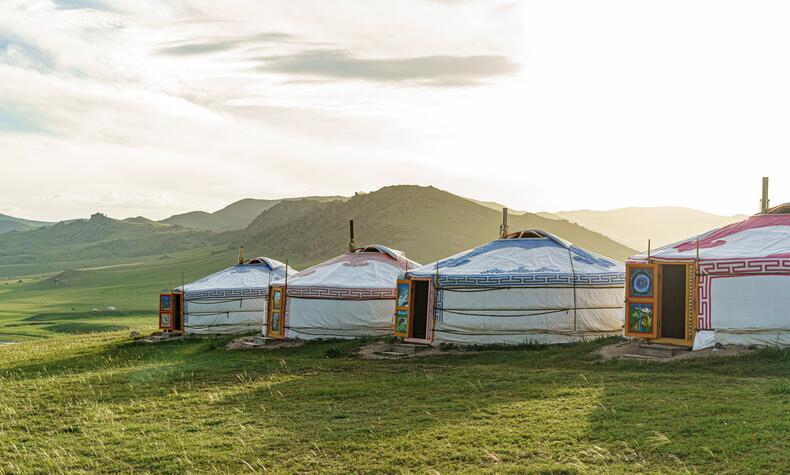
In the heart of the Asian steppe, the Genghis Khan Retreat is a timeless refuge surrounded by silence and spaces that stretch as far as the eye can see.
Once upon a time, there was a manor house located in the little-known Serra da Arrábida, a Portuguese natural park just 40 kilometers from Lisbon. There, surrounded by Muscat and Syrah vineyards, pines, and oaks, Casa Palmela is an exclusive 5-star hotel (the only one that exists within the park). The history of this fairytale house begins in 1630 when it belonged to the Jesuits who used it as a farm and to host the members of the congregation from the neighboring town of Setúbal when they enjoyed their vacations.
In 1889, with the expulsion of the religious groups from Portugal, the estate passed to the state and, at the end of the 19th century, it was bought by a nobleman as a gift for his daughter who was to marry the Duke of Palmela. The house remained in the hands of the same family until 1969, when it was inherited by Bernardo Holstein, Marquis of Mofalim and grandfather of the current owner, also named Bernardo.

From 1974, the date of the famous "Carnation Revolution," until about 2000, the large Holstein family lived here and spent some of their happiest moments. In 2015, the current owner bought the house from the family and remodeled it to open it to guests as a hotel where luxury is based on local authenticity. Bernardo, along with his wife Joana, and his cousin Salvador (director of Casa Palmela), welcomes you in what is also their home with an open heart and a willingness to help you discover not only the corners of this magical house, but an endless number of places and experiences to live and enjoy in the Serra d'Arrábida.


The story of this trip to this unknown and exclusive part of Portugal is full of names. George is the skipper who takes us with his boat, departing from the port of Setúbal, to discover the wonderful coastline of the Serra d'Arrábida bay, which has, on the Troia peninsula, some of the most beautiful and unspoiled beaches in this area of Portugal. On board a boat, the perspective of the landscape and life always changes.
We discover a palace once owned by the Conte d’Armand, a French nobleman who saw the potential to turn the area into a kind of “Portuguese Riviera.” Jackie Kennedy stayed there with her children during part of her mourning, just a week after Kennedy’s assassination. While tasting some of the best local cheeses aboard the boat, accompanied by white wine, we are surprised by a pod of dolphins swimming calmly alongside us. There is a stable family of 40 dolphins residing in the bay.


The next day, the adventure of discovering the area awaits us. We start early in the morning to visit the Mercado do Livramento in Setúbal, one of the most beautiful in Portugal and a gastronomic experience for the senses. We are accompanied by our local guide, Vitor, who invites us to start our walk tasting a shot of "Ginjinha," a traditional sweet orujo made with cherries.
We continue our route through the market tasting some fresh oysters, just brought from the Sado River hatcheries, and some local goat cheeses accompanied by an unbeatable homemade bread and a glass of red wine. And all that without leaving the market!


We decide it's time to walk around a bit and, between convents and fortresses, we learn about the traditional tiles that are part of the aesthetic beauty of the streets, houses, and buildings of Portugal. Since this industry began back in the sixteenth century, they have been made by hand. In some places they are still made, using the same technique as yesteryear, using cobalt as the main pigment to create the traditional, unforgettable blue of the tiles.
Salvador Holstein explains that in ancient times the richest people had yellow tiles in their houses. This color was achieved thanks to the gold dust that Portuguese ships brought from Brazil in the 16th and 17th centuries; the ships returned to Brazil loaded with tiles and Portuguese stone.
We then return to Casa Palmela where it seems that time has stopped and dine accompanied by its owners, Joana and Bernardo, who enliven our evening with all the endearing and interesting stories that are part of the house, the family, and the history of this fascinating area of Portugal.


The next day, a shining sun greets us and accompanies us throughout the day in which we will discover the best of Lisbon aboard a vintage motorcycle with a sidecar. Lisbon is a city that is easy to fall in love with due to its steep streets, its tiled and colorful facades, its streetcars, its people, the imposing Tagus River, and, of course, its gastronomy.
After a mandatory stop at the famous "Fábrica de Pastéis de Belém," where we enjoy a coffee with what I would say is Portugal’s most traditional pastry—made there since 1837 using a secret recipe passed down through the generations—we head up to Alfama, the highest part of the city. There we meet Elena, who accompanies us on a gastronomic tour of small neighborhood establishments, ending at the famous and vibrant "Time Out Market."


But the gastronomic cherry on top of the day is yet to come.
In the evening we head to the Chiado district, where we dine at the restaurant "Bairro do Avillez," owned by the prestigious Portuguese chef José Avillez, who joins us for dinner and shares his passion for Portuguese cuisine, explaining the origin and preparation of the fantastic dishes that we’re tasting.
The chef has different restaurants in Portugal, among them "Belcanto," the first restaurant in Lisbon with 2 Michelin stars.

The last day is reserved for getting to know the surroundings of the farm. We are accompanied by biologist Mario Carmo for a relaxing session of forest bathing, during which he explains, for example, that there are between 30 and 40 species of orchids cataloged in the area and that Esteval, which is the name of the estate where Casa Palmela is located, comes from the name of a flower that is very abundant in the natural park.
Mario explains the project he will soon be implementing with Casa Palmela called "Arrabida Soundscapes." Mario has spent months recording the sounds of a total of 50 locations in the mountains at different times of the day and night, in different seasons, and with different weather conditions. The goal is to place about 50 points on the trails surrounding the estate so that guests can walk around, connect via their phone’s Bluetooth, discover the sounds at each point, and explore nature through hearing.


As was only fitting, we end our journey through the Arrábida Mountains as we started it, in gastronomic style, with a fabulous picnic under the great oak tree that, for decades, has been the true guardian of Casa Palmela.